Nous devons vérifier que votre inscription n'est pas une entrée automatique. Veuillez s'il vous plaît compléter le test suivant:
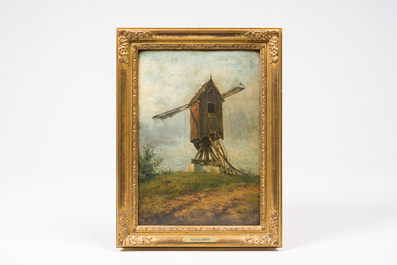
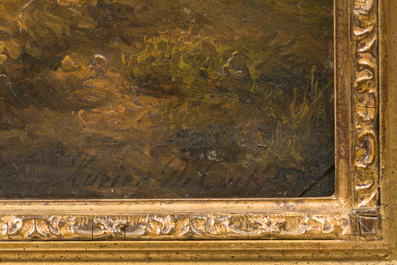
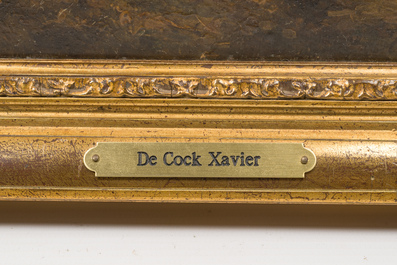
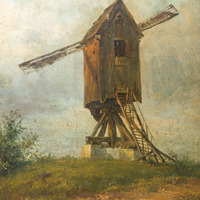
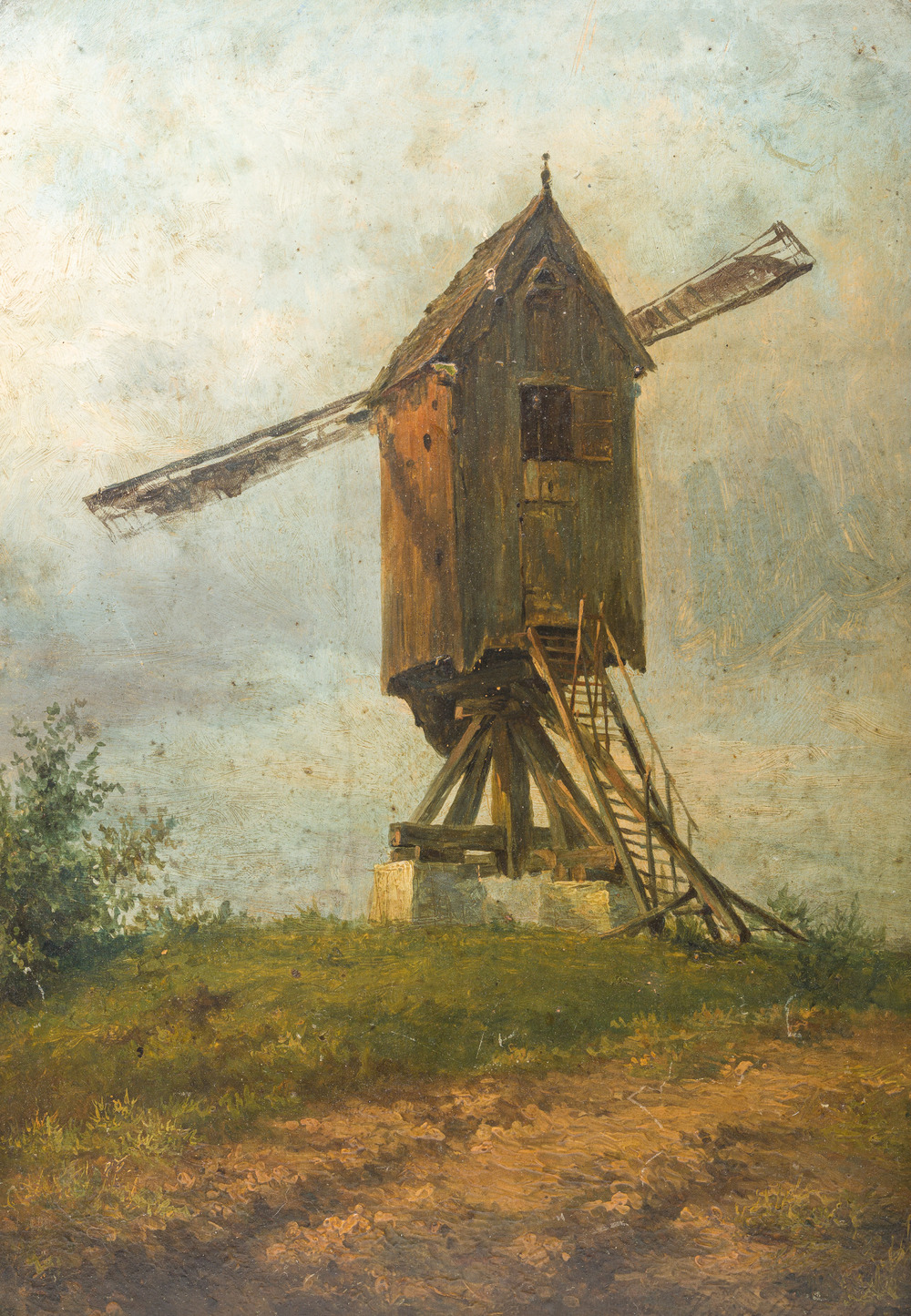
Xavier De Cock (1818-1896): Vue du grand moulin à pivot sur le Molenberg à Deurle, huile sur panneau
817
Work: 34,5 x 24,5 cm
Frame: 42 x 32 cm
Provenance:
- A Belgian private collection.
- With Van Langenhove auctions, Ghent, Oct. 20, 2007, lot 75, described as 'The windmill of Cyriel Buysse'.
However, Cyriel Buysse only commissioned the construction of his small wooden windmill in 1922, to replace the large post mill on the Molenberg or Warande, originally from 1592.
Buysse's windmill had two predecessors in Deurle:
The Coolegem Mill (1547-1583/84)
The Lordship of Nevele owned several fiefs in Deurle, outside its Warande estate, the most extensive of which were "ter Laecke" (15 acres) and "Roothuyse" (18 acres). On one of these fiefs, "ter Laecke," a wooden corn windmill was erected in 1547. This was later called the mill at Coolegem, after the name of the place where it stood. What happened to the windmill after March 12, 1583, is unknown. According to a chronicle from Nevele, in 1584 only the windmill in Nevele-dorp remained standing, while all the others had burned down. Indeed, the entire area surrounding Ghent had been devastated during the Spanish reconquest of our regions, and more specifically the city of Ghent, under Alexander Farnese. Entire villages had been burned down and depopulated. The Coolegem mill was possibly destroyed during these wars.
The large post mill on the Molenberg or Warande (1592-1918)
In 1592, a new windmill was built near the house of Joost van Oost (forestier), the tenant of the Warande, behind the church of Deurle on what is now the Molenberg. This mill succeeded the Coolegem mill, located a little further away, which was probably destroyed in 1583 or 1584. In 1911, the Molenberg estate was sold to the Cyriel Buysse-Dijserinck from Afsnee, who built his wooden stilt house there. The windmill itself, however, was not included. The mill in Deurle was blown up by four retreating Germans from Bremen at 5 AM on November 2, 1918, just a few days before the armistice. Cyriel Buysse deeply regretted this destruction.
The current windmill (1922)
With the compensation received for war damage, Cyriel Buysse had a smaller windmill built in almost the same location in 1922. It was a half-sized pole mill, which initially had two functions: grinding grain and pumping water to supply the stilt house. After his son René Buysse-Nerinckx inherited the Molenberg and its mill in 1932, the small mill fell into disuse. He removed the stilt house in 1939 and built the still-existing thatched villa on the same site.
Estimation:
€ 1500
-
€ 2500