Nous devons vérifier que votre inscription n'est pas une entrée automatique. Veuillez s'il vous plaît compléter le test suivant:
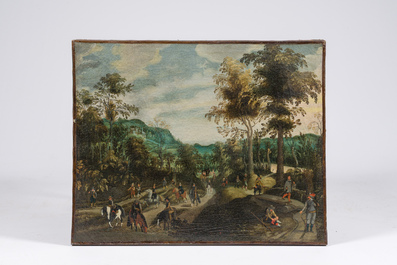
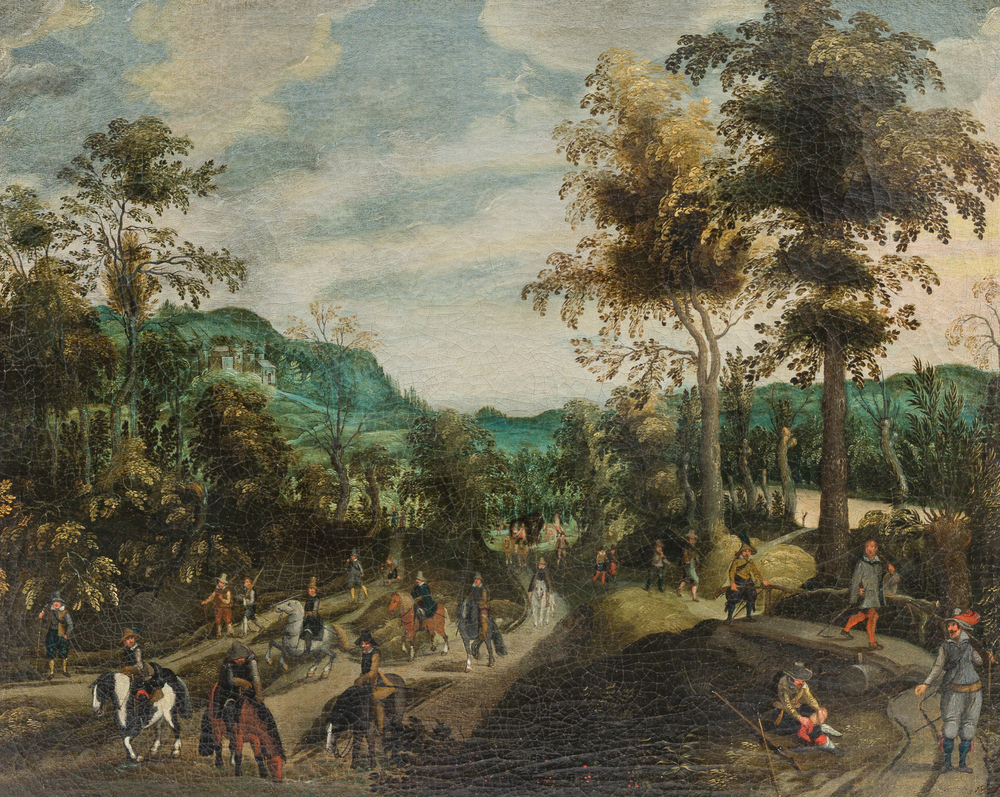
Sebastiaen Vrancx (1573–1647): Paysage vallonné et boisé où des soldats voyagent et se reposent sur la route, huile sur toile, vers 1608-1609
932
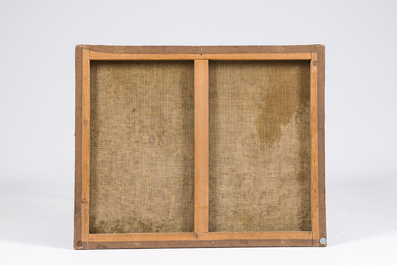
Work: 70 x 55,5 cm
The Antwerp painter and rhetorician Sebastiaen Vrancx specialised in two genres: themes in the Bruegel tradition and small-scale military scenes. In the latter quality he is identified in the Iconographia - a famous series of engraved portraits of notable people of his time after drawings by Van Dyck - as 'Pictor Proeliorum Minorum / Cohortis Civium Ductor' (painter of military skirmishes / Captain of the Civil Guard): a combination of a painter and someone well versed in matters of arms. As Captain of the Civil Guard he was responsable for the security at night in a designated quarter of town. The way he is portrayed, wearing a sabre, refers more in particular to his membership of the Guild of the Fencers, one of the Antwerp armed guilds. Moroever, archival documents prove that he was instrumental in arms deliveries for the Spanish Army. Therefore he was well placed to depict soldier’s life in paint. In this respect he showed, as in this picture, a predeliction for horses and cavalry.
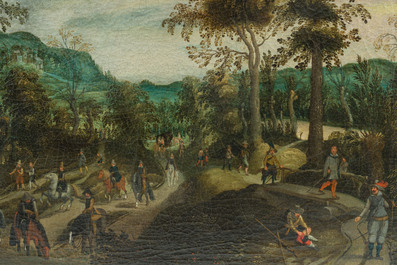
A company of light cavalry has halted on the road in a hilly landscape with trees. They let their horses water at watering hole in the center foreground. To the right a group of musketeers walks towards the viewer while one of them is sitting down and putting his socks right with his musket and its support fork lying next to him on the ground (muskets were heavy and needed such a support stick). Soldiers on horseback and more musketeers are approaching on the road; and in the far background, partly covered by trees, one even sees the tiny figures of a civil company riding in a covered wagon. Those were the sort of civilians who followed an army train to provide food, drinks, clothes and logistics to the soldiers proper. One finds such rather peaceful military scenery in a landscape more often in Vrancx’s oeuvre: a very lovely painting of the sort is his 'Rest of the Soldiers' in the museum Kunsthalle in Hamburg.
The wealth of anecdotic and colourful detail in rendering the soldiers’ poses, clothes (uniforms were not yet common in Vrancx’ time), weapons and individual horses, is typical for Vrancx. From correspondence between artists and art dealers of his own time, we learn that he invested a lot of time in painting such details and that this made his paintings time-consuming and expensive already then. To this very day this attention to lively anecdote still consists one of the most attractive aspects of his art.
It is often assumed that Vrancx specialised as a figure painter, mostly only complementing landscape backgrounds by a specialised landscape painter. This proves to be a false assumption: many times landscapes are also by his own hand as is the case here.
His style from the period between 1610 and 1625 is very well known but this alone offers a very reduced insight in his oeuvre: in reality dated works by his hand range from 1594, preceding his journey in Italy (1596 – 1601) till 1647 (the year of his death) and show quite some evolution in style. According to the style in which figures, horses and landscape are painted here, this picture can be dated at the end of the first decade after his return from Italy, about 1608-1609. Especially the type of pittoresque pollard willows and treetops that are segmented over several levels are typical for that period.
We would like to thank Dr. Joost Vander Auwera for writing this catalogue entry after a visual inspection of the work (autumn 2025).
Estimation:
€ 8000
-
€ 12000